Who Is Research For? The Results—and Our Plan to Close the Gap
Research · By Matt Barker (Digit the APE), Adapted Physical Education specialist
Published · Updated
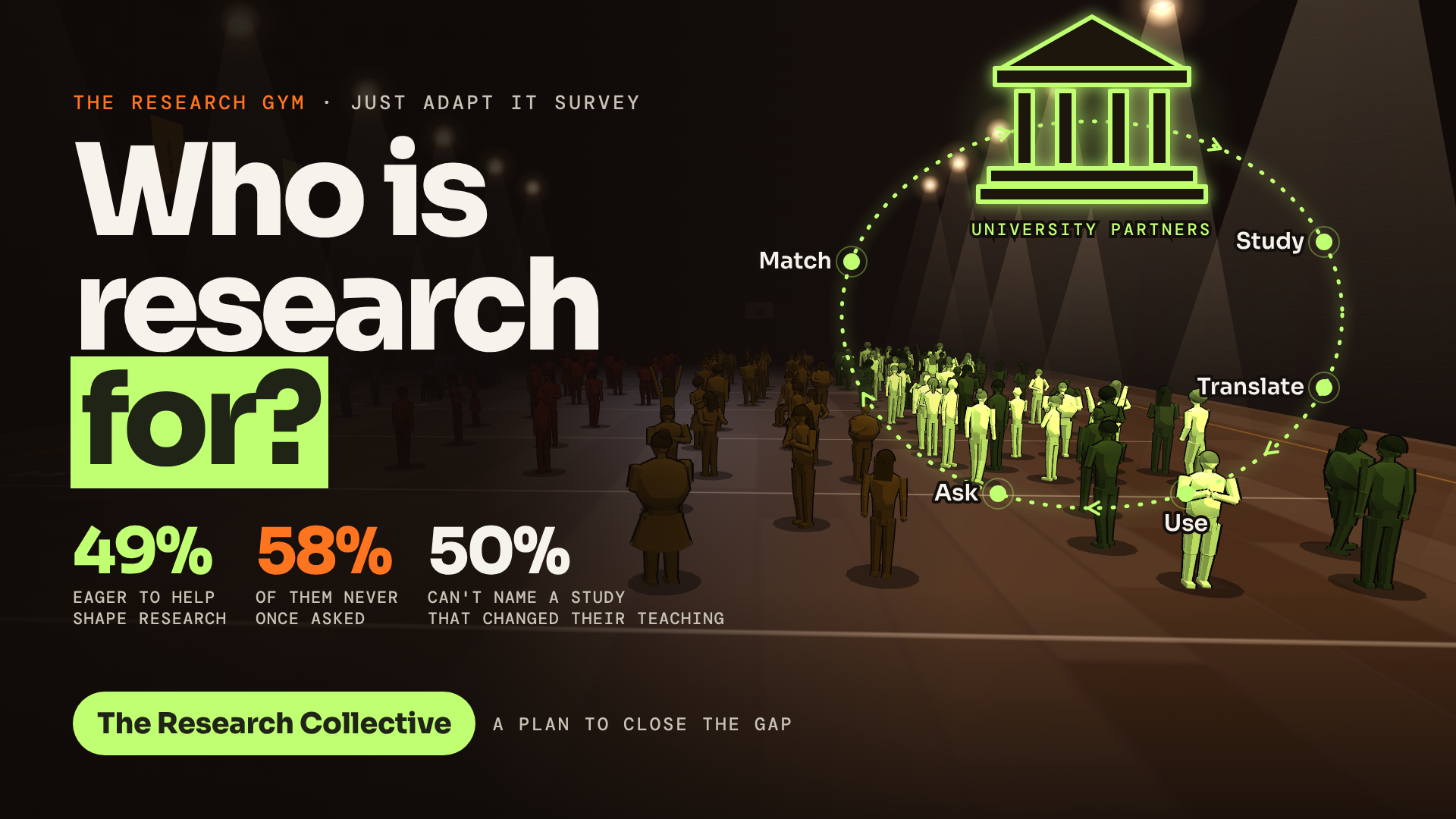
Half of the 145 educators and therapists we surveyed couldn’t name a study that changed their teaching. Yet 71 want to help shape research—and 41 have never been asked. Our proposed Just Adapt It Research Collective would bring practitioners into the process, from choosing the questions to using the findings.
Who is research for?
We asked 145 adapted PE teachers, PE teachers and therapists where research fits in their work. Half couldn't name one study that changed how they teach. Yet 71 told us they're eager to help shape research, and 41 of them have never been asked.
Every year, universities publish studies about teaching movement to children with disabilities. Every day, adapted PE teachers make hundreds of decisions about exactly that. The two worlds rarely meet.
This fall we ran a short survey called Who Is Research For? We wanted to know how research actually reaches the people in the gym: how often they read it, where they learn instead, what gets in the way, and whether they want a seat at the table.
The answers were clear. The problem isn't that teachers don't care about evidence. It's that the system was never built to include them. Below you can walk through the results in 3D, read the numbers plainly, and see what we think Just Adapt It should build next.
Step inside the Research Gym
Every figure is one respondent. Scroll through the story and watch them sort into lanes by their answers. At the end, walk around and click anyone to read what they wrote.
What 145 educators told us
Mostly adapted PE teachers, and mostly veterans
Nearly two-thirds of respondents (91) work in adapted PE. 92 have been in the field more than ten years, and 51 of those have more than twenty. That matters for everything below: these are experienced professionals, not newcomers who haven't found their footing.
More than a third rarely or never read research
55 of 145 (38%) said they read research once or never. Only 16 read it monthly or more often.
Half couldn't name a single study that changed how they teach
72 said no, 17 weren't sure, and 41 said yes. Experience helps only a little. Among people with five years or less, 7 of 35 could name one. Among those with more than twenty years, it was 18 of 51, and 19 of them still said no.
Journals reach 1 in 5. They shape the teaching of 1 in 50.
28 people use peer-reviewed journals at all. Only 3 of 145 named one as the source that most influences their teaching. Conferences, Facebook groups and colleagues do most of the work. Research isn't absent from this field; it just arrives secondhand, if it arrives.
The walls are paywalls, time and relevance
The top five barriers each hit about a third of respondents. Only 12 people said they face no real barriers at all. Notice what's missing from the top of this list: nobody's main complaint is a lack of interest.
Confident finding it. Stuck using it. Far from the people doing it. Ready to help.
Read these four questions top to bottom and the story tells itself. Most people rate their ability to find research a 3 or higher. Only 17 find it easy to turn into practice. Far more feel distant from researchers (56) than close to them (23). And then the bar swings hard the other way: 71 rate their interest in contributing a 4 or 5 out of 5.
71 want in. 41 have never been asked.
This is the finding we keep coming back to. A large group of experienced, motivated practitioners is willing to help, and the research system has no way to find them. When we asked how they'd take part, they didn't only offer to fill in surveys. Half would test new teaching strategies in their own classes.
rate their interest in contributing to research a 4 or 5 out of 5
of those have never taken part in a research study
would test interventions or teaching strategies in their own setting
want to suggest the problems and questions that deserve research
104 pieces of advice for researchers
Research is often conducted in such “precise” conditions that findings prove or disprove points that are completely opposite to real world class settings.Adapted PE teacher · under 2 years
Make it easy to find. Availability is the best ability.Adapted PE teacher · 2–5 years
Follow up after with those involved.Adapted PE teacher · 21+ years
Drill down with practitioners on why they do certain strategies. Finding out what practitioners mean when they say “it works”!University faculty · 21+ years
All of the research articles on core strength norms are from the 1980s and I am finding that today's kids are not comparable.Physical therapist · 21+ years
Researcher could collaborate directly with practitioners throughout the research process to ensure the findings address real-world needs.Adapted PE teacher · 11–20 years
Understand our issues by having a discussion forum to hear from our Adapted PE community about the issues we are facing on campus.Adapted PE program coordinator · 21+ years
90 questions nobody is studying yet
We asked, “What's one question you wish researchers would investigate?” Here is every answer, unedited. Service delivery models, inclusion in general PE, assessment for older students, deafblind learners, para support, caseloads. If you're a researcher looking for a study that teachers will actually read, start here.
The Just Adapt It
Research Collective
One respondent's wish for research was six words long: “Concerted collaborative effort to lift the field.” That's the plan.
Every person in this survey found it through Just Adapt It. Teachers use our tools to plan lessons, write goals and run assessments. One respondent told us our newsletter is their main source of professional influence, and added: “If it had links to research articles or journals I would read them.”
We think a platform like ours can do much more than link. We propose a professional research collective: a network where practitioners set the questions, contribute to studies, share in the data, and get the findings back in a form they can use on Monday morning. Researchers get willing partners and real classrooms. Kids get teaching that's been tested in gyms like theirs.
This has worked before, in other fields
Bridging research and practice is an old problem. One widely cited review in medicine estimated it takes about 17 years for research to reach everyday practice. Other professions built structures to close the gap. Adapted PE deserves one of its own.
Cooperative Extension
The Smith-Lever Act linked land-grant universities with every U.S. state to carry research directly to farmers and communities. It still runs today.
Practice-based research networks
Groups of primary care practices where working clinicians help shape the questions and studies run in real clinics. Over 120 are registered with AHRQ.
Research-practice partnerships
Education's own model, defined in a William T. Grant Foundation paper by three traits: long-term, mutually beneficial, and organized around problems of practice rather than researchers' interests.
England's Research Schools
A network of 32 schools that help others turn evidence into practice through training and school-to-school support. Over 11,000 schools have used them since 2016.
How the collective works
Every study follows the same loop, and practitioners are inside it at every step.
- Ask
Members post the questions they face in the gym and vote on which matter most.
- Match
University partners adopt top questions and co-design studies with a member panel.
- Study
Member classrooms opt in as study sites, collecting data through tools they already use.
- Translate
Every finding becomes a one-page brief, a short video and a ready-to-run activity.
- Use
Members try it, report what happened, and that feedback becomes the next question.
Back to Ask. The loop is the point: findings return to the people who made them possible.
Six things we'd build, and the data behind each
The Question Exchange
A public board where members submit and upvote research questions. Researchers can browse it, adopt a question, and tag it as “in study.” We'd seed it on day one with the 90 questions above.
32% say research topics don't feel relevant to their setting, and 45 want to suggest what gets studied.
The Open Brief Library
Free, plain-language translations of research that matters to APE: a one-page brief, a two-minute video, and a “try it Monday” activity card for each study. No paywall, no jargon.
36% are blocked by paywalls. 56% want practical examples and 46% want short videos. Only 17 find translating research easy.
The Classroom Research Network
Members opt in as study sites. They test strategies, run standardized observations and collect data through Just Adapt It tools, with training and clear protocols provided.
76 would test interventions, 44 would collect standardized data, and 41 want training to do it well.
A shared, member-governed dataset
De-identified assessment and goal data, pooled with permission, to build modern norms and answer questions no single district can. It is never sold. Partner universities apply for research access, and members see results first.
Teachers told us the norms they rely on are decades old and the assessments they have don't fit older students.
Credit for the work
Participation counts. Members earn professional development certificates, contributor credit on published work, and a research profile that records every study, survey and brief they helped create.
35% say they don't have enough time. Research has to count toward the PD they already need.
Closing the loop
Every study run through the collective reports back to the people who took part, in plain language, with what it means for their classes. Researchers join live sessions to talk with members directly.
56 feel far from researchers (1 or 2 out of 5). Only 23 feel close.
Who gains what
Practitioners
- A say in what gets studied
- Free, usable research summaries
- PD certificates and public credit for contributing
- Results from classrooms like theirs
Researchers
- A ready pool of willing study sites
- Questions that practitioners have already vetted
- Standardized data across many districts
- A direct channel to share findings
Students
- Teaching built on evidence from real gyms
- Modern norms that reflect today's kids
- Better-defended service decisions in their IEPs
The road from here
Open the conversation
Publish these results. Launch the Question Exchange with the 90 teacher questions. Invite founding members and university partners.
Run the first studies
A founding cohort of member classrooms pilots two or three studies with partner universities. The first briefs go into the Open Library.
Build the data network
Opt-in, de-identified data from member tools starts building shared norms that partner universities can study and members can use.
How founding membership works
The founding group shapes the collective before anyone else joins. This is what we're proposing, and we want your feedback on all of it.
- Who
- 50 to 75 practitioners from across the field, plus two university partners. Anyone who teaches, coaches or provides therapy in movement for kids with disabilities can apply.
- Cost
- Free. Founding members never pay to belong.
- Your commitment
- One short survey a month and a vote on research questions each quarter. Joining a study is always your choice, one study at a time.
- Who decides
- A member council of seven practitioners, mixed across roles and years of experience, plus one researcher representative. Members vote on the top questions, and the council chooses which ones go to university partners.
- Ethics and student data
- Every study is approved by the partner university's ethics board (IRB) and by your district before it starts. No student data is shared without district approval and a signed data-use agreement.
- Recognition
- Certificates of participation for your professional development records, contributor credit on published work, and a founding-member badge on your research profile.
- Funding
- University partners include the collective in their grant budgets, and sponsors fund the free brief library. Data access is never sold, to universities or anyone else.
Research should be built with the people in the gym, not just about them.
If you teach, coach, treat or research movement for kids with disabilities, we'd like you in the founding group. Tell us what you'd study, what you'd test, or what you'd want to read.
Join the founding collective →About the survey
Who Is Research For? was an online survey run by Just Adapt It from September 13 to 29, 2026. We received 146 submissions and removed one exact duplicate, leaving 145. Respondents found the survey through the Just Adapt It website (101) and blog (44). 95% work in the United States.
This is a self-selected sample of people already connected to Just Adapt It, so it is not representative of all PE or adapted PE teachers. People who chose to answer a survey about research may also be more interested in research than average. Counts include only people who answered each question. Free-text answers are shown unedited. Names and emails are not included.
In the 3D gym, body shapes, heights and wheelchairs are assigned at random for variety. The survey did not ask about them.
Sources
- Morris, Z. S., Wooding, S. & Grant, J. (2011). The answer is 17 years, what is the question: understanding time lags in translational research. Journal of the Royal Society of Medicine. Summarized by WashU Public Health.
- U.S. Senate Committee on Agriculture: 100th anniversary of the Cooperative Extension System.
- Agency for Healthcare Research and Quality: Practice-Based Research Networks.
- Coburn, C. E., Penuel, W. R. & Geil, K. E. (2013). Research-Practice Partnerships. William T. Grant Foundation. Via Education Week.
- Education Endowment Foundation: Research Schools Network.
Topics: research, survey, adapted PE